Posts

The Wild Hunt: Symbolisms, Meanings, and Folklore (Part 4)

Image
Part 4: Krampus, Perchtenlauf, Warrior Initiations, Werewolf and Other Shamanic Symbolisms by Sean Jobst 4 January 2022 "Die Wilde Jagd" (1856-1857) by the German landscape painter Johann Wilhelm Cordes    After nearly a year, I resume my Wild Hunt series which generally ties in with other themes of folklore, mythology, and spirituality. I ended  Part 3  with some insights from Carl Jung on the Wild Hunt and fairy-tales like the Pied-Piper of Hamelin as allegories for "ecstasy" and "going berserk" that connected to Wotan. He connected that fairy-tale to Wotan as the "unleasher of frenzy and passions" ( Entfeßler von Rausch und Leidenschaften ), whose "essence is ecstasy" ( Sein Wesen ist Ekstase )(Jung, 75). We now know from anthropologists and folklorists that fairy tales have  ancient origins  going back thousands of years, so its only natural they preserve those traditions.     Such is the Wild Hunt, whose furious sounds and supernat...

The Wild Hunt: Symbolisms, Meanings, and Folklore (Part 3)

Image
Part 3: Wotan as archetypal leader of the Wild Hunt; folkloric figures relating to him by Sean Jobst 26 January 2021 1896 work by Swabian painter Hans Thoma (1839-1924), which formed the costume design for Wagner's "Der Ring des Nibelungen"    In the previous post , I examined the qualities of Frau Holle or Perchta as leader of the Wild Hunt. Yet other traditions cite the Germanic god Wodan as the One who leads the Wild Hunt. This is not surprising given that Holle/Perchta seems to be the same as his wife, Frija - the different names depending on the region and time period (much like Wodan gradually became known as Wotan due to developments in the German language) . Their roles would be complementary towards each other, making the Wild Hunt a balance of the masculine and feminine power forces that exist within Nature. "Not only Wuotan and other gods, but heathen goddesses too, may head the furious host: the wild hunter passes into the wood-wife, Woden into frau Gaude...

The Wild Hunt: Symbolisms, Meanings, and Folklore (Part 2)

Image
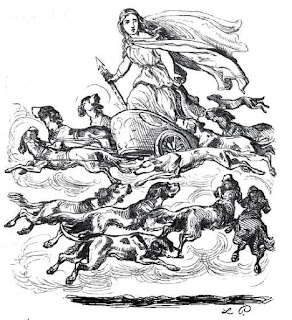
Part 2: Frau Holle and Perchta; seasonal symbolisms of the Wild Hunt by Sean Jobst 31 December 2020 "Frau Gode" by the German painter Ludwig Pietsch (1824-1911)    Continuing from Part 1  concerning the Wild Hunt, special attention should be made about the Germanic goddess variously known under her regional names as Perchta/Berchta in Southern Germany, Frau Holle in Central Germany, and Frau Herke/Freke/Gode/Wode in Northern Germany (Heath, 5). She is Vrouw Holle in Flanders and the Netherlands. All share such close associations with Frija, the wife of Wodan, that we can hypothesize they're one and the same - as is most pronounced with the Wild Hunt: "Frau Holle, elsewhere called Perchta, rushes through the airs at the head of her procession, and the people below either put some food on their roofs, or set a special place at the table"(GardenStone, 110). She is mentioned in many fairy tales and folklore. Jacob Grimm conceived of Holle as originally a sky goddess...

The Wild Hunt: Symbolisms, Meanings, and Folklore (Part 1)

Image
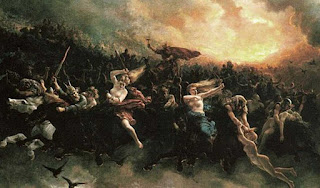
Part 1: Introduction; various cosmic and natural symbolisms; timing and relation to holidays by Sean Jobst 29 December 2020 "The Ride of Asgard" (1872) by Norwegian painter  Peter Nicolai Arbo, portraying the Wild Hunt    There is an undercurrent of ancient wisdom deeply embedded in folklore and traditions. This is a basic truth I have come to recognize these past few years, leading me on a journey I can only describe as enlightening. It was a task I took up in my past examinations of folklore, identifying remnants of the ancient Germanic goddesses Zisa  and Ostara , and the various traditions and legends around the auspicious time of Walpurgisnacht . Using that same basic format, I will now examine traditions, folklore, and legends about the Wild Hunt - a pan-European motif with its regional variants. I will focus more on the Swabian and Alemannic, Flemish, and Iberian traditions of my ancestral lands, with parallels in nearby cultures so as to gain a deeper pi...